Ongoingness
Vielmetter Los Angeles is pleased to present Ongoingness, a group exhibition featuring artists from the gallery’s program and anchored by a pivotal work by Pope.L that was created for his first solo exhibition with the gallery in 2015.
Entitled Heaven (Vielmetter Version), this work provides a framework for a range of reflections on the nation’s past, present, and future as we mark the 250th anniversary of the United States. It charts a course forward in the midst of tremendous upheaval, both for the vision of the gallery and for our personal relationship toward a country that has undergone profound social, environmental, and political change since our family immigrated here 36 years ago.
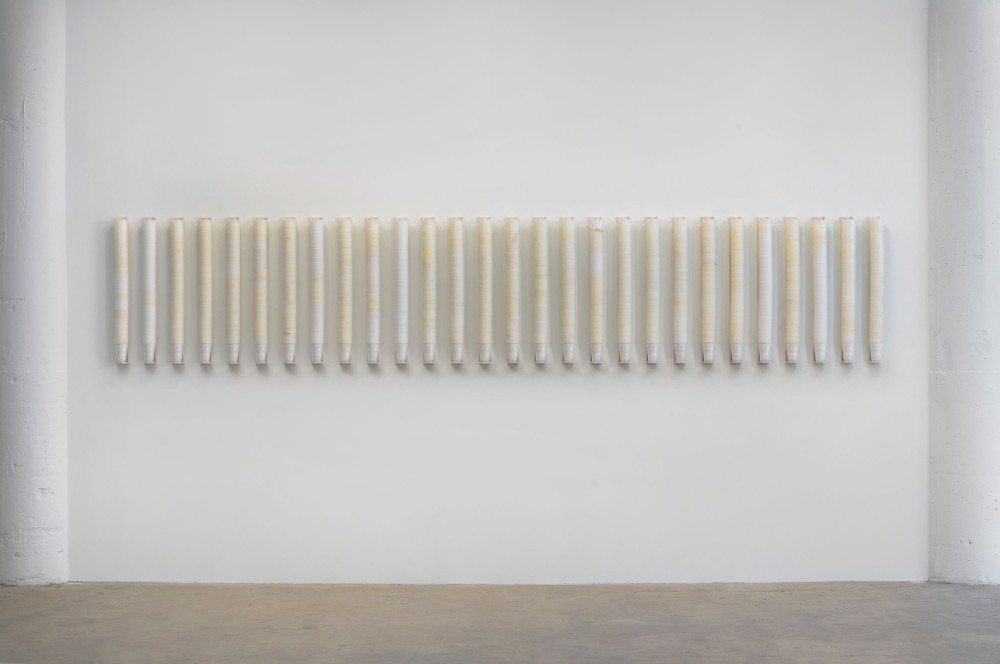
Heaven is one of Pope.L’s most materially austere, yet visually elegant works. Consisting of 28 columns of stacked disposable plastic water cups that have yellowed and stained with age, it adopts the purist aesthetics of minimalism and alludes to the Duchampian idea of the art object as a container for meaning. Pope.L references these pillars of the avant-garde while also invoking darker histories, such as the role of a drinking fountain as a tool for enforcing segregationist policies in the Jim Crow era.
Pope.L wields materials that translate the conceptual into the experiential: sticky surfaces, liquids, containers, binaries, abbreviated language. Often, his work gives form to absence, to a lack that is deeply felt but not easily articulated. There is a corporeality to Pope.L’s work that is hard to capture with words or images alone – it engages with the entire space and the entire body. It breathes, lives, ages, deteriorates, and transforms. It speaks of big things with small words. It encapsulates vast contradictions: it is fragile, vulnerable, sobering, and it is also loud, visceral, and punctuated by a sense of humor that borders on the hysterical. Pope.L’s work demonstrates that it is possible to try and fail again and again, to exhaust all possibilities and still drag oneself onward. Many of his performances and installations are designed to exist in multiple iterations and variations that respond to a particular time and place. Pope.L was interested in what he called “ongoingness” and with the act of enduring, which he defined as something that is ongoing, but under stress.
The works in the exhibition comprise a lens through which we can see from a perspective under duress. They offer an encounter with an image or an experience mediated by a human eye, hand, body and brain in all its glorious fallibility. They earn our attention, beckoning us to come closer. In Andrea Bowers’ painstaking rendering of a section of the AIDS memorial quilt in storage, drawing becomes a devotional act, one that forges a tangible connection between the signifier and the signified, the image and its subject. Paul Sepuya’s photographs engage the viewer, the artist, his muse, and his camera in complex and seductive entanglements. Samuel Levi Jones takes as his raw material the American Flag and the bound covers of law textbooks, which are shredded and pulped and thoroughly digested before he meticulously reconfigures them into thickly textured abstractions on canvas.
This physical undoing is echoed in Robert Pruitt’s fantastical portrait of a woman standing in the middle of a cyclone of broken furniture and household items that she appears to be telekinetically disassembling, and in Nicole Eisenman’s flagpole that slouches limply to the ground and spews an oil-like substance from its tip, not unlike the twisted metal and iridescent puddles left behind after a firestorm. The eagle, normally situated on top of the flagpole, has crashed down into a box, both legs broken from the fall.
In Rodney McMillian’s work, black tumor-like protrusions fashioned from chicken wire and duck cloth distend from the surface of a found cast iron piggy bank, giving substance to a malignancy that permeates the doctrine of bootstrapping American individualism.
The drawings of Karl Haendel exploit the medium’s elasticity and economy, enlarging images to tenfold their actual dimensions without sacrificing precision or clarity. Here, he shows the image of an eagle, inflated in size, yet paper thin in material. Dave Muller reverently crafts larger-than-life replicas of music albums from his extensive collection, using the labor of reproduction and experiments with scale and materiality to pay homage to the culture of a generation in a certain place at a certain moment. Nate Lewis’ intricate works on paper allow bodies and patterns to materialize from careful incisions, gouges, and indentations pressed into their surfaces. The figures are suspended in poses reminiscent of dance as they practice capoeira, a form of martial arts used to covertly hone one’s readiness for battle. A glazed ceramic suit of armor sculpted by Liz Glynn hangs from a steel frame like a protective costume waiting to be worn, its carapace-like surface contoured around an absent body.
Alec Egan’s painting thrums with the ominous sensibility of a horror film – a tastefully lit home in an undefined Southern California neighborhood sits on a vacant street after sunset, flanked on either side by a floral curtain that acts as a kind of proscenium for the unfolding scene. It’s unclear whether something terrible is about to happen, or whether it has already occurred behind closed doors. Ariane Vielmetter’s drawing depicts two butterfly species endemic to Altadena as they survey a void that once harbored a community of over 9,000 homes before it was ravaged by the Eaton fire. Both artists lost their homes and studios to the Los Angeles fires of 2025, and their recent works have grappled with the psychological and material ramifications of catastrophic loss. In Hugo McCloud’s sprawling abstracted landscape, the site of his former home in Mexico is filtered and obscured through a grid of textured aluminum foil that has been embossed with a floral motif from a hand-carved stamp. The work revisits a site of past trauma and makes tangible the contours of grief and absence.
Through storytelling, art can sometimes deliver a closer approximation of reality than science or journalism or other sources of objective knowledge. It can challenge prevailing narratives of the inevitable, imagine other futures and unearth overlooked histories. The paintings of Mario Joyce flesh out the oral histories of his ancestors by incorporating collage elements and soil gathered from the site of his upbringing. Wangechi Mutu’s collages source images from fashion magazines, medical texts, and anthropological publications, integrating these readymade textures into the bodies of regal, fantastical and sometimes violent figures.
Deborah Roberts centers her gaze on Black children, combining collage and painterly figuration in portraits that capture both the beauty and precarity of their lived experience. In drawings that depict geological strata and architectural ruins from an era neither present nor past, Edgar Arceneaux weaves together myths and historical narratives. His drawing of a “blind pig” references the racially motivated police raids on drinking establishments that incited the 1967 Detroit Uprising. Mary Kelly’s work revisits the slogans of historical protest movements that have effected change and approaches the language itself as a material, capable of relating both to the body and landscape.
Pope.L’s seminal work, “Trinket”, an immensely sized American flag whipped into horizontality by enormous industrial fans, loomed over viewers with undeniable animus when it was presented at MoCA’s Geffen Contemporary in 2015. The sheer force of the wind keeping it aloft caused the flag to come apart at the seams over the course of the exhibition, an unraveling tapestry of both consensus and disagreement. Pope.L thought of the flag as a kind of prosthesis onto which we project our desires and our deficiencies. Sometimes being an American means coming face to face with the brutal shortcomings of a social infrastructure that seems to serve and protect only a privileged few. Sometimes, it means waking up after a life-upending catastrophe to find a makeshift gift economy forming on the periphery of disaster – strangers and neighbors pooling resources to shelter the displaced, restock lost clothing, and donate enough fresh produce and homecooked meals to make a socialist blush. It is to be confronted with unconscionable greed and confounding generosity. The founders of this country peered into the uncharted terrain of the future and perceived both peril and possibility. They conceived of the constitution as a living document that could and should be adapted to the needs of an ever-evolving citizenry. To be an American is to partake in its Ongoingness, to look toward the still unwritten future and recognize both risk and potential, and to persist onward.
-Ariane and Susanne Vielmetter, July 2026