Makiko Kudo: Reincarnation
Perrotin Los Angeles is pleased to present Makiko Kudo’s first solo exhibition with the gallery, Reincarnation. Across a series of oil paintings, the Japanese artist captures a harmonious world between animals, humans, and nature, inspired by the life and death of her beloved pet cat.
Makiko Kudo paints vividly enchanting worlds. Her canvases are fantastical technicolor landscapes, rich explorations of flora and fauna, usually centered on a single figure. They appear androgynous and adolescent, sometimes self-absorbed and staring into space, sometimes flying in a dream-like state. One shimmies up a tree, a koala bear clinging on to them. Another floats across a pond, a capybara sitting upon their back. Around them, animated brushstrokes bring to life lush forests and cityscapes, clusters of camellias and cherry blossom, and a menagerie of animals – from black swans to swallows to sharks. There are shades of manga and anime in the storytelling, wrought with expressionistic energy.
The results are magical and mystical, yet rooted in real experiences. In her new body of work, which will be exhibited at Perrotin Los Angeles, the fantastical and often monumental scenes all have a starting point in Kudo’s own life. She captures poignant moments, translating her initial feelings of a place into paint, layered with snippets of other narratives —from conversations with friends to novels she has read.
In Light (2026), a vibrant flower-strewn and sun-soaked hillside summons up a park in Seoul, seen by Kudo at dusk. The woodland setting of A Heavenly Drive (2026) was inspired by a trip to Iwate, a prefecture in the north-east of Japan’s main island of Honshu, and the memory of driving through the dappled light among the trees. Iwate’s coastline, meanwhile, is at the heart of “Jōdogahama”(2026); Jodogahama Beach becomes a cliffside composition of turquoise sea and rocky islands, inhabited by a colony seagulls, but dominated by an eerily floating figure, red-headed and wearing a fluro-pink dress, with a white cat resting on their stomach.
This flight of imagination is also personal to Kudo. Last August, her cat of nearly 19 years, Momen, passed away. The loss is woven through the paintings she has made over the past seven months. A sense of the spiritual prevails. One vast and vivid canvas dotted with numerous creatures is titled Reincarnation (2026), a belief that Kudo adheres to.
Forty eight-year-old Kudo was born in Aomori, at the northern tip of Honshu. As a child she loved drawing, but “there were no museums there then,” she recalls. It wasn’t until Kudo was a teenager and her family moved to Kanagawa, south of Tokyo, that she first saw oil paintings. She became enamoured with the 18th-century depictions of nature by reclusive Japanese painter Itō Jakuchū. Discovering the work of Matisse and Bonnard was a revelation, she says. Her own paintings first gained recognition in 2002, when they were featured in the second edition of Tokyo Girls Bravo, a group show of emerging female artists curated by Takashi Murakami.
Today her home studio in a leafy western suburb of Tokyo reveals more contemporary inspirations. One figurative wooden sculpture is by Keisuke Yamamoto, an artist also represented by Tomio Koyama Gallery in Tokyo. He advised and assisted Kudo in creating her own sculptural forms, also carved in wood, for her 2022 solo show at the Hiratsuka Museum of Art in Kanagawa.
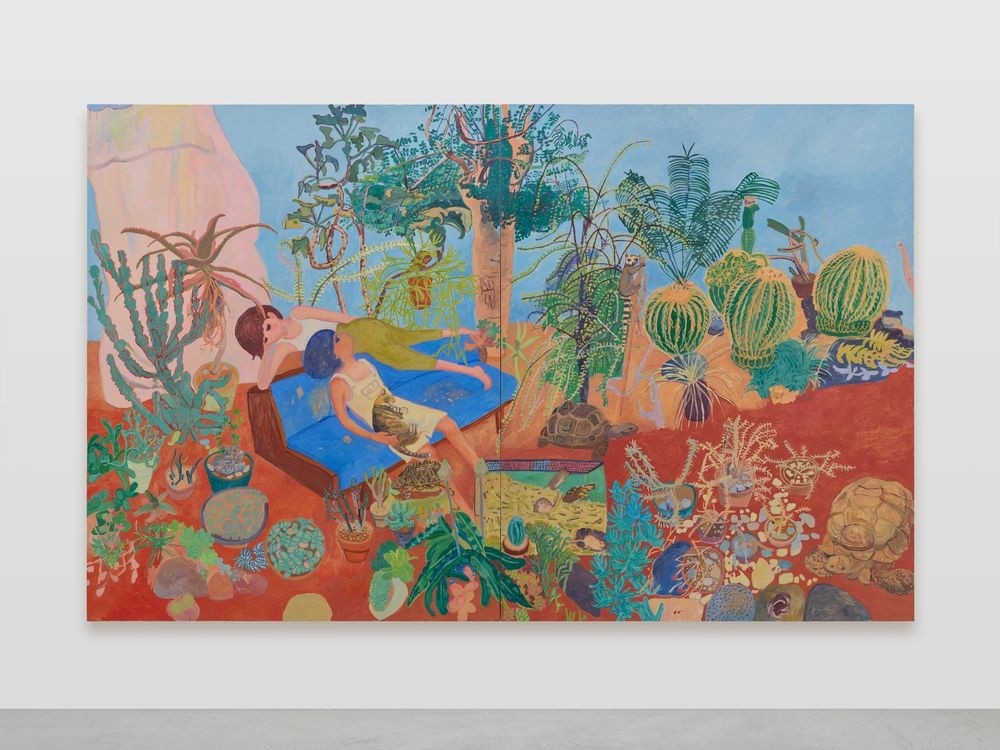
Painting, though, remains Kudo’s primary focus. Her daily studio practice is punctuated with visits to nearby green spaces: to Equestrian Park, where she can see horses, and the greenhouse at the Tokyo University of Agriculture. The latter, a space Kudo says she would happily move into, is depicted in another new painting: We’ll Explore When the Time’s Right (2026). Among cacti, succulents and crawling tortoises, Kudo has placed a sofa that two teenagers lounge upon.
The characters in Kudo’s paintings are “both myself and other people at the same time,” she explains. They exude child-like joy, but also sadness. Despite the vibrant colours and kawaii vibes, Kudo’s images often ache with loneliness and longing. They hark back to her own memories of childhood: a time when she was often alone and would conjure imaginary worlds.
A series of smaller paintings zoom in on the protagonists. With titles such as A Crocodile Friend (2026) and It Seemed Like the Moon (2026), they are intimate snapshots that ultimately leave you wanting to know so much more. Who is this person? What are they thinking? What is their story? These questions are at the heart of all of Kudo’s paintings. Whether they are huge complex dreamscapes or single moments in miniature, they are both visually enticing and endlessly intriguing.