Liu Xiaodong: Host
For the renowned figurative artist’s latest painterly journey and his first exhibition in Los Angeles, Liu Xiaodong visited another American city last year, focusing his documentation of a stay in Detroit on a single, central focus for the first time in his career. His sole subject is John Mcintyre, a Detroit-based tattoo artist and member of a local medieval fighting team, who is variously depicted by the artist in full armor, mid-battle in a snowy forest, or else at home, relaxing in a hot tub. The concentration of this painting project on one man, the host and conduit for all of the artist's interactions with the city, leads Liu to portray industrial and suburban Detroit through the lens of John and his loyal band of brothers.
Trained in the painting traditions of socialist realism in his native China, Liu has since travelled far and wide – to twenty-three countries, across five continents – to create a global portrait of humanity from Syrian refugees, orphans in Greenland and Mexican migrants, to Indonesian socialites, casino-goers in Macau and a royal family in the Middle East. For his Detroit project, Liu initially envisaged painting perhaps retired workers from the motor industry or maybe rappers from the influential music scene, but as often occurs in his on-location practice any pre- conceived notions or carefully researched plans change radically once on the ground. Liu also predominantly paints al fresco and on-site, which proved to be a challenge during a bracing Midwest midwinter. Chancing upon the figure of John, embedded in Detroit subcultures and historical battles, allowed Liu to train his brush on one ‘host’ individual, somehow representing the wider communities he embodies.
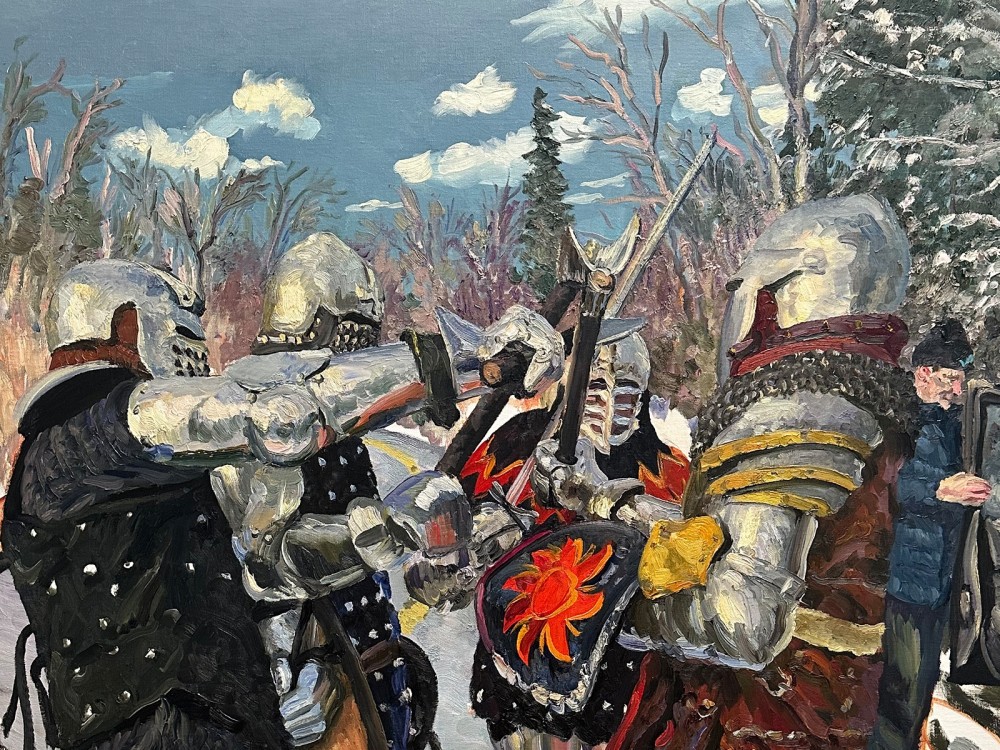
For the epic scene of armed combatants in a blizzard, entitled Snowlight in Detroit (2025), John is seen with his fellow fighters from a club called Knyaz USA, named after a Medieval Reenactment club from Ukraine who share the red sun livery and sigil. Joining in 2019, John competes with his team in a competitive, full-contact sport known as Buhurt or Historic Medieval Battles, in leagues and world tournaments, where opponents aim to strike blows with blunted steel weapons, with strict rules and regulations on engagements that can feature up to 30 fighters on each side. The painter can be seen wearing a blue jacket in the background, seemingly lost in his own world, while those around him are threatened with losing their heads.
John is portrayed in multiple scenarios, either in full combat gear or stripped to the waist but emblazoned with tattoos, sporting a different kind of bodily armor. He is seen both at work – in the piece titled Body (2026), inking his designs across the clients’ torso and legs – and at rest – lounging in the hot tub for Backyard (2025). Even in the heat of the battle, Liu’s main subject is recognizable with his axe, shield and chainmail, seemingly stepping out of the twenty-first century into a pre-Raphaelite fantasy or a medieval war zone as painted by Paolo Uccello or Piero della Francesca.
Rather than heroicizing this painted knight, Liu considers the importance of outsiders and individuals in society, as well as the communities and camaraderie that both create and encircle any one person. There is also a recognition that everyone employs one form of armor or outward protection in times of isolation or when threatened by external forces. A new documentary film and catalogue will accompany the show, featuring Liu’s diary and preparatory drawings, as well as folkloric illustrations and tattoo designs by his sitter.
Liu Xiaodong is a painter of modern life, whose large-scale works serve as a kind of history painting for the emerging world. Liu locates the human dimension to such global issues as population displacement, environmental crisis and economic upheaval, but through carefully orchestrated compositions, he walks the line between artifice and reality. A leading figure among the Chinese Neo-Realist painters to emerge in the 1990s, his adherence to figurative painting amounts to a conceptual stance within a contemporary art context where photographic media dominate. His undertaking ‘to see people as they really are’ was galvanised after graduating from the Central Academy of Fine Arts and, alert to the legacy of Chinese Socialist Realism, his compositions are painted with loose, casual brushstrokes and layered with meaning. While he works from life and often en plein air, he chooses sitters to supply ancillary narratives to landscapes or situations. From recent location-specific series, such as Transgender/Gay in Berlin, featuring portraits of the transgender woman Sasha Maria which were featured in Liu's first comprehensive retrospective 'Slow Homecoming' in Düsseldorf, to his London series Half Street (2013), as well as The Hotan Project (2012-13) in the Xinjiang province of China, Liu has also created an automated painting machine entitled Weight of Insomnia (2016), which translates a digital video feed of traffic streams and human movement in real time into a new body of paintings tracing time, memory and behaviour. In Borders (2021) at the Dallas Contemporary, Liu embedded himself within Texas region communities, documenting individuals, locations and contemporary societies. He describes a varied world animated and enriched by diversity, where family and collective values stand out as primordial, communal means for peace and fraternity. In so doing, Liu re-assesses painting in the age of internet and algorithm and implicitly invokes the present condition, in which humans and other objects reciprocally co-create the world as we know it.