Felipe Suzuki
We find beauty not in the thing itself but in the patterns of shadows, the light and the darkness, that one thing against another creates. . . . Were it not for shadows, there would be no beauty.
—Jun’ichirō Tanizaki, “In Praise of Shadows” (1933)
Felipe Suzuki begins his compositions like a still life painter: arranging objects such as fruit on a table, paying attention to how light dapples the skin. Rather than working from observation, however, the São Paulo–based artist paints through the lens of memory, calling on the sensations and associations prompted by the initial act of looking. The resulting luminous, tranquil oil paintings register both visual and unseen worlds. “Sometimes our perspective,” he notes, “is realer than reality.” The works in this exhibition, his first solo show with Karma, were all made in 2026.
Suzuki uses centuries-old painting techniques to create work that is only allusively representational. Forms cohere to varying degrees, but, in his words, his paintings’ “spirit is abstract.” His compositions’ tonal harmony stems in part from his primary use of the Apelles palette, named after its Ancient Greek originator: four pigments, variously combined to produce a vast array of hues. Suzuki’s careful attention to the relationality and mutability of color—set against warm ochre and sienna, gray morphs into blue, and so on—embraces the alchemy inherent to perception. “A color is almost never seen as it really is,” Josef Albers wrote in 1963. Darkness exists only in relation to light. That the senses can propel us beyond the material world is the centrifugal force of Suzuki’s practice.
Although his paintings register, from a distance, as serene or even delicate, proximity reveals density and surface texture that borders on topographic. Each work is composed slowly, built up through several layers of oil sometimes mixed with calcium carbonate—a compound responsible for, among other uses, fusing Renaissance frescoes with the wall or ceiling. The artist has devised a system for stretching and mounting his canvases on wood to support the weight of their many strata. These function more like sculptural armatures than substrates; like the frescoes, his paintings form part of a greater architectural whole.
Modernist genealogies, too, can be traced in these works. Suzuki’s spare spatial poetics have a kinship with the still lifes of Giorgio Morandi; beyond their tonal and compositional affinities, the artists share the conviction that absence is a presence in its own right. “What matters,” Morandi remarked, “is to touch the background, the essence of things.” Often translated in English as “negative space,” the Japanese concept of ma describes the intervals between objects and actions. Rather than connoting lack, ma frames the pause as charged, significant. Suzuki, whose practice is keyed to this philosophy, is equally attentive to forms as he is to the space produced by their contours. His mother has described him “painting the air.”
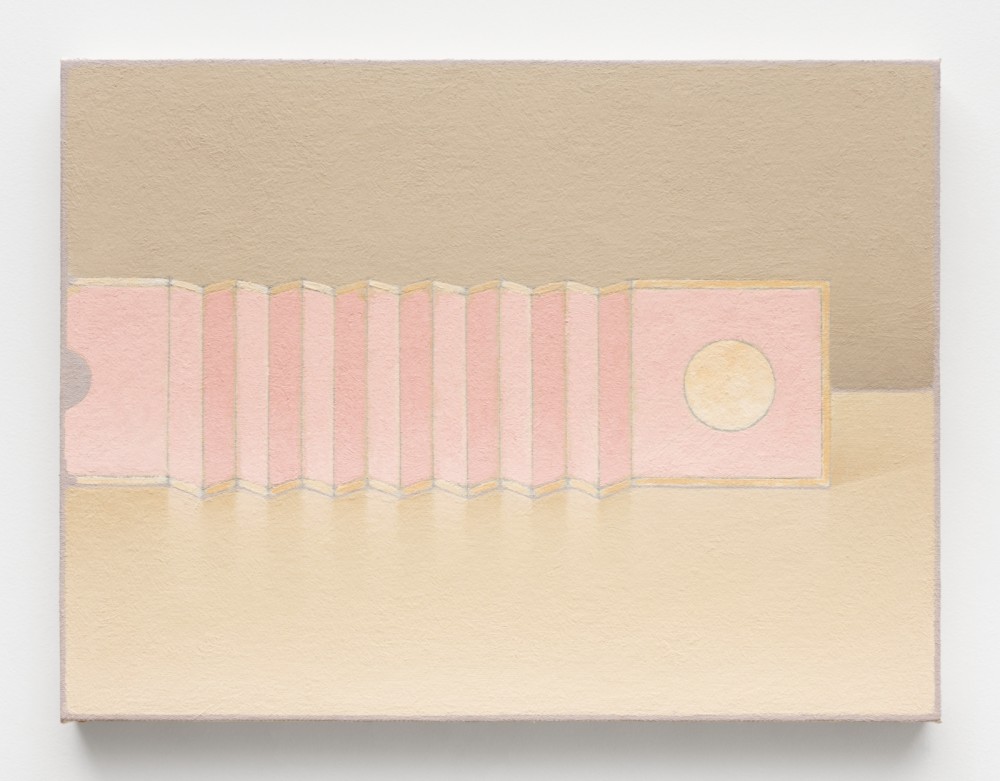
Suzuki draws on a concise vocabulary of fundamental geometric forms. Even at his most abstract, his play with depth and shadow lends simple shapes an iconographic valence, as if hinting to origins in the known world. A neat semicircle rising from the bottom edge of one painting is pale and lunar, the material limits of the canvas its horizon. Some rectangles extend horizontally, accordion-like, in pleats—the artist relates this motif to his recollections of folding screens in the homes of his Japanese parents and grandparents. Soft shadows haloing the slim, monochromatic strips that recur across several paintings imply three-dimensionality. Presented this way, the rectangular forms recall Minimalist sculpture of the 1960s—as if John McCracken’s planks, which he installed leaning against the wall, were cast in the subtler hues of Anne Truitt or Agnes Martin.
Compositionally, these five works by Suzuki echo the typical structure of art photography: a piece on a wall, a strip of floor below for scale. This association concretizes in a painting of a painting, a miniature seascape in a setting just architectural and ivory-washed enough to connote the proverbial “white cube.” But the work’s apparent realism fades on closer inspection—Suzuki has, almost imperceptibly, broken the rules of perspective and shadow. In fact, many of his pictures seem to follow the dream logic key to Metaphysical art and early Surrealism. Contextual clues suggest pictorial coherence: a line in one painting becomes a stick of incense thanks to a ribbon of smoke billowing from its crown and the vessel below. But gravity doesn’t exist in this painting’s world, and so representation soon dissolves into a collection of shapes—all the more evocative for their role in this disintegration.