PAIGE POWELL PRIVATE ANDY: RELIGIOUS SERVICES
Jeffrey Deitch presents two bodies of never before seen photographic work by Andy Warhol’s friend and associate Paige Powell.
Private Andy: Religious Services brings together intimate photographs and ephemera made by Powell during the mid-1980s, revealing a private and deeply human dimension of Warhol and the social, spiritual, and artistic world that surrounded him. Drawn from Powell’s extensive personal archive, the exhibition centers on two photographic series: PRIVATE ANDY, Double Exposures, 1987 and Religious Services, Volunteering at The Episcopal Church of Heavenly Rest, New York City, 1986.
Paige Powell arrived in New York in 1980 from Portland, Oregon and soon began working at Andy Warhol’s Interview magazine, where she ultimately became associate publisher, overseeing advertising, marketing, media, and public relations. She worked closely with Warhol on commissioned art projects and was a constant presence alongside him at dinners, parties, openings, and public events. As Glenn O’Brien once observed, “If Warhol had a wife, it would have been Paige Powell.” Warhol himself wrote in The Andy Warhol Diaries in 1985, “I really like Paige.”
Beginning in 1981, Powell documented her life and community through 35mm and Polaroid photography, slides, film, and video. Her photographs appeared regularly in Interview and have since been published in The New York Times, The Wall Street Journal, Brutus, and numerous books and exhibition catalogues, including The Andy Warhol Diaries. Throughout her fourteen years in New York, Powell was a central figure within the downtown cultural scene and played a formative role in the careers of artists, writers, designers, and musicians, including Jean-Michel Basquiat, Stephen Sprouse, Lady Pink, Rammellzee, and others.
The series PRIVATE ANDY, Double Exposures, 1987 consists of a group of accidental double exposures created over a ten-day period, from February 17, 1987 to February 27, 1987. The images span from a fashion event at The Tunnel Nightclub, where Andy Warhol and Miles Davis modeled for Japanese designer Kohshin Satoh, to Warhol’s funeral and burial in Pennsylvania. When Powell later reviewed the images together on a single contact sheet, she recognized them as haunting and historically resonant. The double exposures unite Warhol with people he loved, some of whom were not physically present at his funeral, brought together unexpectedly within a single frame. Friends including Stephen Sprouse, Brigid Berlin, and Tama Janowitz appear superimposed across scenes of mourning, procession, and burial, creating images that feel at once accidental, intimate, and spiritually charged.
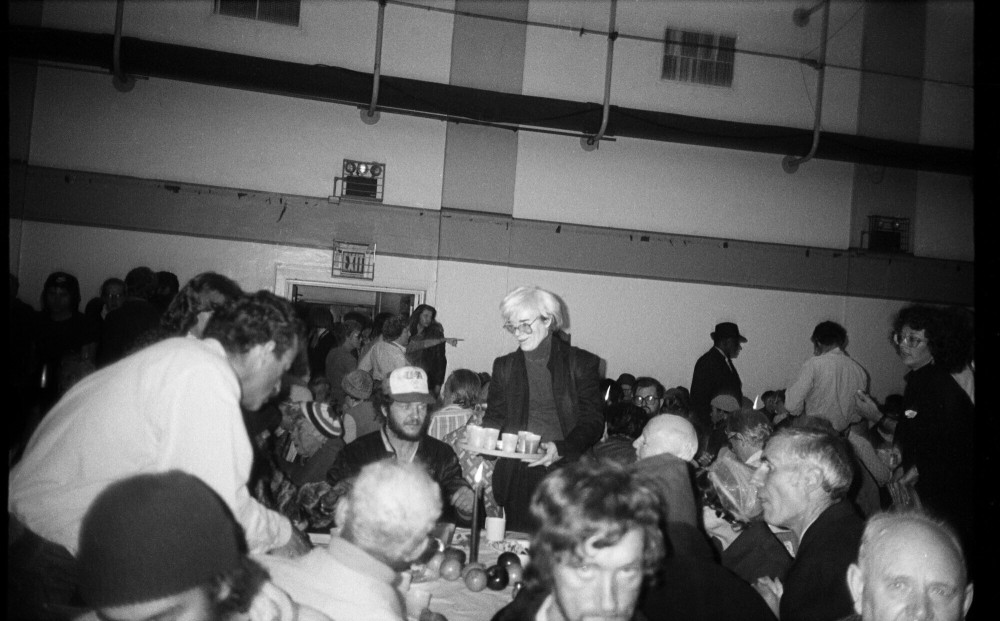
In contrast, Religious Services, Volunteering at The Episcopal Church of Heavenly Rest, New York City, 1986 documents a quieter, largely unseen aspect of Warhol’s life. Through Powell’s close friendship with Warhol, she came to know his empathy and desire to help others. In 1985, after Powell began volunteering at Mother Teresa’s Missionaries of Charity in the Bronx, Warhol expressed interest in volunteering as well, though closer to where they lived on the Upper East Side. Together, they found the Episcopal Church of the Heavenly Rest, where they volunteered during Thanksgiving and Christmas meals for the homeless and those with nowhere else to go. Powell’s photographs capture Warhol not as a public figure but as a dedicated volunteer, busing tables, serving coffee, cleaning up, and quietly returning again and again. The images reflect a sense of safety, humility, and belonging that Warhol felt within the church community.
Taken together, the works in Private Andy: Religious Services offer a rare and personal portrait of Andy Warhol seen through the eyes of someone who knew him deeply. Powell’s photographs resist spectacle, instead revealing moments of grief, care, labor, and devotion. The exhibition presents not only an intimate view of Warhol, but also a broader reflection on friendship, spirituality, and the unseen labor of community that shaped a pivotal moment in New York’s cultural history.
Paige Powell (b. 1950) lives in Portland, Oregon and continues her work as a photographer, curator, and animal rights activist. Her ongoing focus is bringing her extensive analogue archive to life through books and exhibitions.