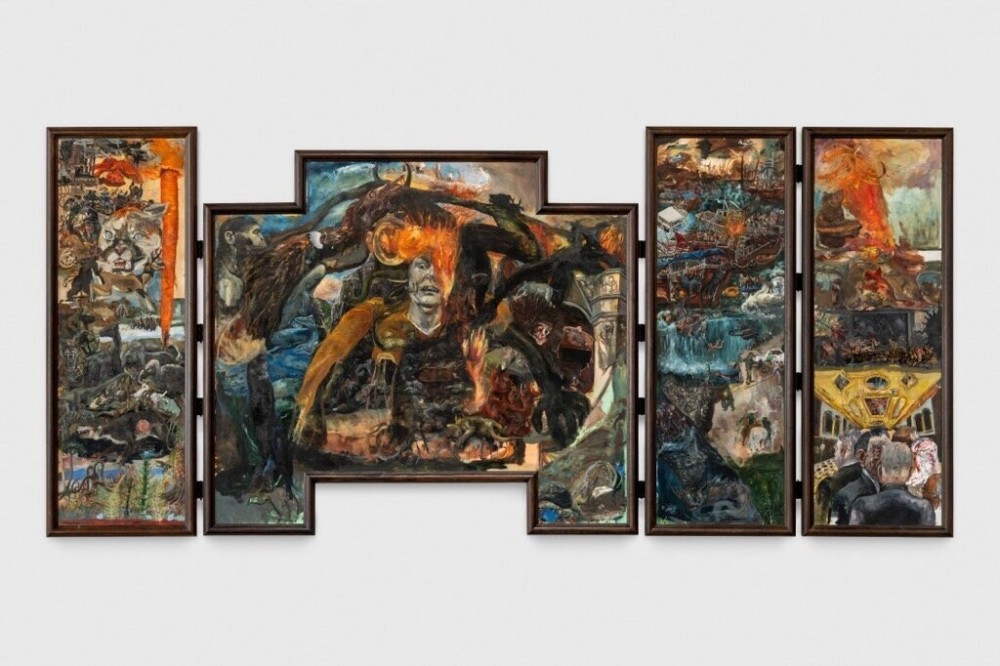
Celeste Dupuy-Spencer: BURNING IN THE EYES OF THE MAKER
Celeste Dupuy-Spencer (1979-2026)'s solo exhibition BURNING IN THE EYES OF THE MAKER will now be opening on Saturday, April 18, during our regular gallery hours 11am-6pm.
At a certain point, in recent years, I was at a crossroads: stop painting, or find another way to understand what painting actually is—what it can actually do. I decided to turn fully toward painting and away from Art.
The art world likes to talk about power—resistance, critique, progress—but it is an economy first, a social sorting mechanism second, and only sometimes a meaning-making structure. I didn’t understand at first that my paintings would be structurally inseparable from that world. Whatever I thought they could be collapsed under the weight of transaction. They became possessions circulating inside an unregulated market. I learned that attention without ethics is extraction, and that the art world can reward extraction while calling it insight.
The first works from this shift were religious and mythological paintings. These figures are already cemented in the mind’s eye of the world. The paintings were not attempts at critique or impersonation; they were genuine attempts to reach out, or up. Myth survives because it describes something structurally true about being alive. It is what certain kinds of truth look like once they’ve passed through the human brain.
In the studio, painting became the primary site of meaning. I stopped moving toward an image. There was no final picture waiting to be achieved. A mark was made. The painting answered, and I answered back. The work proceeded as a conversation rather than a construction. Painting became a functional technology guiding me toward a depth otherwise inaccessible—not toward personality or intention, but toward something older and quieter.
The figures that arrive do not behave like symbols. They interrupt. They demand translation. I do not command them or aestheticize them. I listen, or I fail to listen and pay for it. That is the relationship.
Painting, for me, is participation in the aliveness of life. It is communication as recognition, not explanation. Meaning emerges only through encounter—when a viewer and a painting agree to stand in the same place and face the same uncertainty. The task is contact.
- Celeste Dupuy-Spencer
Celeste Dupuy-Spencer (b. 1979 - 2026, New York, NY) lived and worked in Los Angeles. Her work has been featured in major exhibitions including the 2017 Whitney Biennial and Made in L.A. 2018 at the Hammer Museum. Her paintings are held in prominent public and private collections, including the Aïshti Foundation, Beirut; the Hammer Museum, Los Angeles; the Los Angeles County Museum of Art (LACMA); and the San Francisco Museum of Modern Art (SFMOMA).
Burning in the Eyes of the Maker is her first solo exhibition in five years. The show will be followed by a monograph of the same title published by Monacelli/Phaidon, featuring a text by Nina MacLaughlin. The artist statement above is adapted from her introduction to the book.