James Gobel: Hellbent For
de boer (Los Angeles) is pleased to present Hellbent For, a new exhibition by James Gobel, an artist whose meticulously crafted works have long expanded the possibilities of queer material culture. This exhibition situates Gobel’s latest paintings within a broader conversation on domestic aesthetics, coded visibility, and the generative intimacy of queer communal experience.
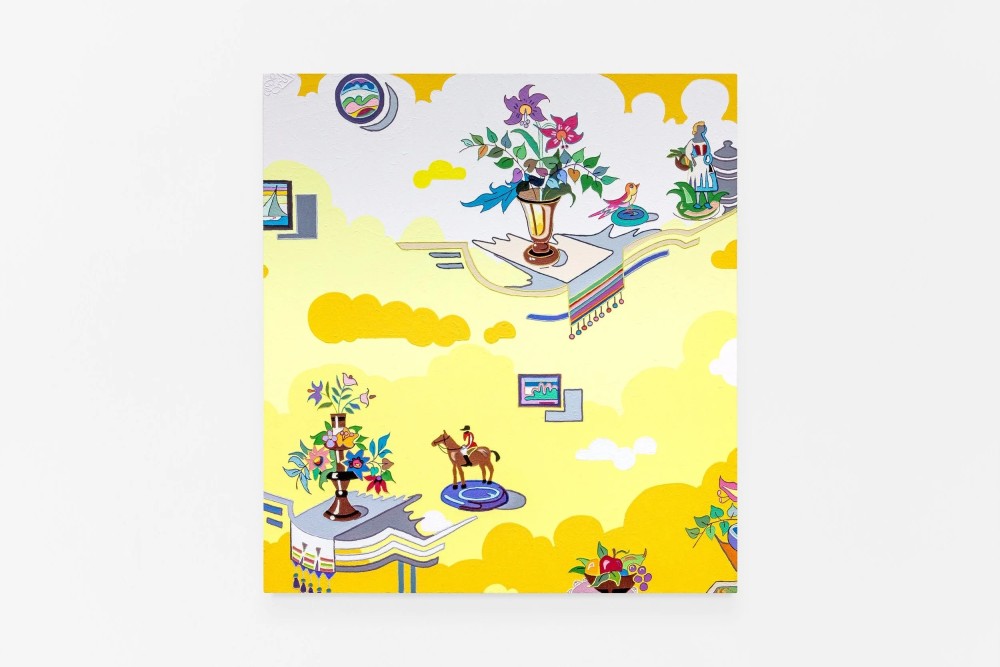
Gobel’s new works mark a decisive evolution in his practice. Moving beyond the mosaic felt and paper-cutting techniques that have defined his earlier oeuvre, using Flashe paint to construct calibrated fields of color that reveal shifting patterns, textures, and passages of embroidered linework. These stitch like contours, deliberate and often playful, create surfaces that hover between the ornamental and the architectural. The paintings unfold as ornate domestic tableaux, at once tender, the paintings soften the aspirational aesthetics of home décor while gently parodying its decorative ambitions.
The intimate infrastructures of queer life, its private jokes, its covert signals, and its chosen iconographies all surface subtly across the works. Embedded in Gobel’s compositions are buried linear passages: signatures, forthcoming dates, and personal or cultural emblems. One painting conceals the letters “JP”, a nod to the Judas Priest logo that, for the artist, bridges childhood memory with the queer resonance later revealed through Rob Halford’s public identity. In tracing this lineage, Gobel honors narratives that shape both the self and the communities he inhabits. His paintings join a long and vital tradition of queer storytelling in which making becomes an act of preservation, resistance, and future-building.
The paintings function like small theaters, each one a stage where memory, desire, and coded communication converge. Across the canvases, patterns, decorative objects, wry pastoral references, curling plumes of smoke, and the sentimental presence of pets and keepsakes populate the stage-like picture plane. These objects—seemingly whimsical, and often humorous, serve as quiet witnesses to daily life. Gobel imbues them with emotional charge, acknowledging how the things we collect and live among bear our stories and become extensions of our interior worlds.
James Gobel (b. Portland, OR) has had solo exhibitions at the Hammer Museum, Los Angeles, CA; de boer, Los Angeles, CA; Bozo Mag, Los Angeles, CA; Et. al., San Francisco; Kravets/Wehby Gallery, New York; Marx & Zavattero, San Francisco, and Steve Turner Contemporary, Los Angeles. Group exhibitions those at Marin MOCA, Marin, CA; Orange County Museum of Art, Costa Mesa, CA; McNay Museum of Art, Houston, TX; San Jose Museum of Quilts & Textiles, San Jose, CA; Long Beach Museum of Art, Long Beach, CA; Akron Art Museum, Kenmore, OH; Sheldon Art Museum, Lincoln, NE; Leslie+Lohman Museum of Art, New York, NY; Asian Art Museum, San Francisco, CA; Des Moines Art Center, Des Moines, IO; Cornell Fine Arts Museum, Winter Park, FL; Marjorie Barrick Museum, Las Vegas, NV; Bellevue Arts Museum, Bellevue, WA; Kemper Museum, Kansas City, MO; Las Vegas Art Museum, Las Vegas, NV; Serious Topics, Los Angeles, CA; Andrew Edlin, New York, NY; Maryland Institute College of Art, Baltimore, MD; Akron Art Museum, Akron, OH; Roberts & Tilton, Los Angeles; CA; Angles Gallery, Los Angeles, CA. His work has been written about in The New York Times, The Los Angeles Times, Artforum, Art in America, and Beautiful Decay, as well as numerous catalogs. He received his BFA from the University of Nevada, Las Vegas and his MFA from the Univeristy of California, Santa Barbara.