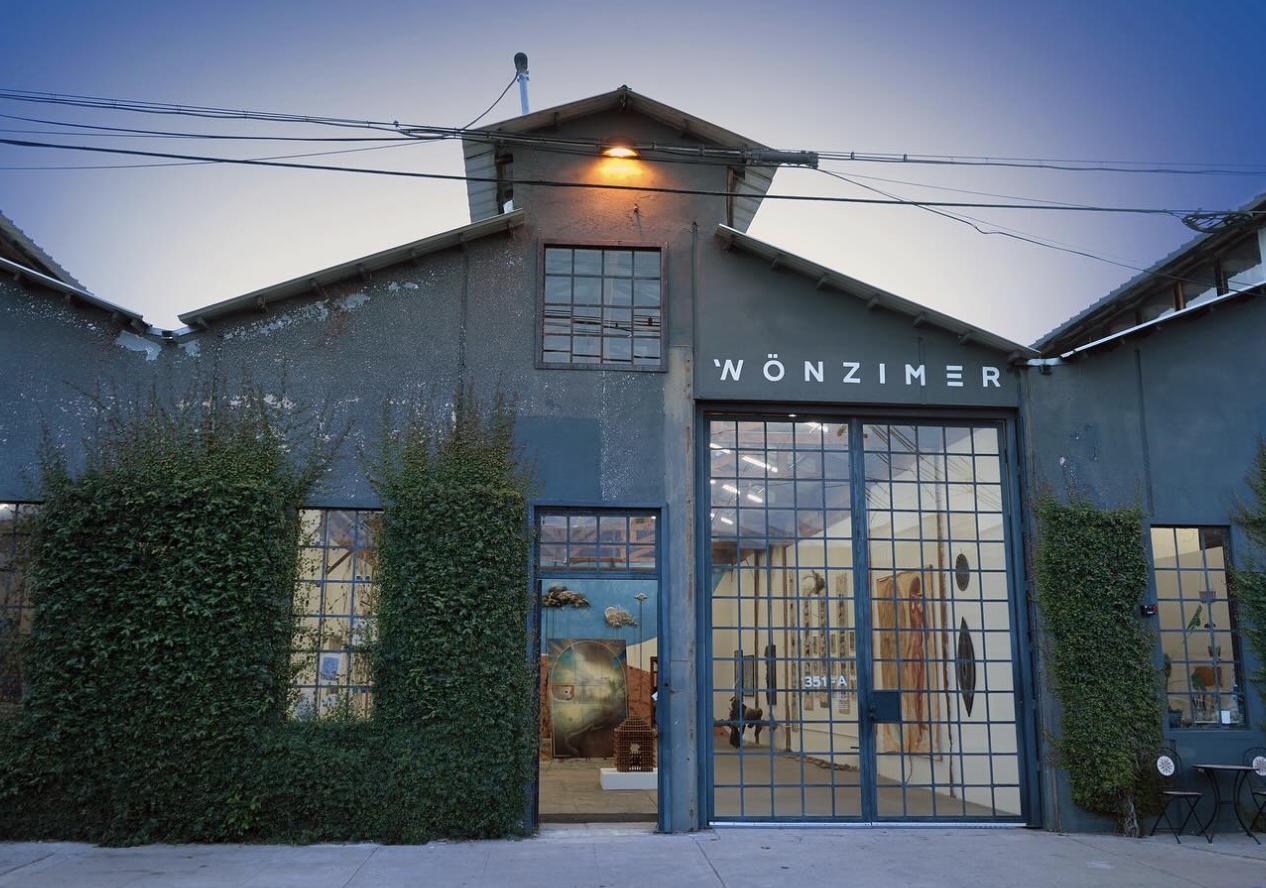
From the Living Room: Wonzimer in Utopia/Dystopia and Beyond

Around nine years ago, Wonzimer co-founders Aidan Nelson and Alaïa Parhizi met on Craigslist. Nelson, then working in hospitality, was looking for a roommate; Parhizi answered the listing and moved in. They began going to gallery openings across Los Angeles, then returning home to debrief–often in their living room–circling the same frustration: the galleries felt sterile. They started imagining something else entirely–a lived-in art space, where people engage more directly with the work and diverse mediums coexist without hierarchy.
After about a year of conversations, Nelson and Parhizi signed a lease on a small space in Koreatown. Wonzimer was born. The name itself, German for “living room,” is the mission statement. It points back to those early conversations and forward to their vision for the gallery: comfortable, porous, and open to exchange.
At their current Chinatown location, that ethos is alive. Tucked behind a hidden bookshelf door within the gallery space is an actual living room. Adjacent to the main gallery are thirteen artist studios, occupied by Los Angeles-based artists who feed that spirit of community and experimentation. Wonzimer mounts roughly ten exhibitions per year, and group shows are central to their program. Despite bringing together such an array of artists and mediums, Wonzimer is curatorially focused–each show is carefully framed around a theme or question.

Their current exhibition, DegreeZero: Utopia and Dystopia in Contemporary Art, was curated by artist-curators Constance Mallinson and Lawrence Gipe. The show takes on a concept that could easily collapse into cliché but is instead investigated with nuance. Here, utopia and dystopia are not opposites but interdependent conditions–each necessary and present in the other. Thirteen participating artists imagine a utopia and dystopia, and together they present a complex, uncanny reflection of contemporary life, where we are caught between democracy and totalitarianism, big tech and nostalgia, innovation and rot.

Mallinson’s accompanying essay sets the conceptual and emotional register for the exhibition. Written in a looping, incantatory voice, framed as the musings of an old woman, it moves restlessly across the last century of American life and death. Her language accumulates rather than resolves: postwar optimism gives way to countercultural rupture, to the hollow triumph of consumerism, and the endless churn of technological “progress.” References collide–Ginsberg’s Moloch, Reagan-era slogans, communes, superhighways, Instagram utopias–until history begins to feel less like a linear narrative and more like a dense, unstable surface, layered with competing truths. The final image–the old woman still returning to her paintings after a lifetime of utopia/dystopias–does not conclude the essay or the exhibition so much as fracture them open. What is art in the face of all this?

Like Mallinson’s essay, the show unfolds less linearly than as a field of signals, where utopian aspirations and dystopian fallout continuously fold into one another. Keith Walsh’s Socialist Workers Party U.S. and Descendants (2021) is an intricate web that maps the Socialist Workers Party’s history as a sprawling, almost unruly timeline. Its formal complexity of lines splintering and connections ricocheting in every direction produces a sensation akin to reading Mallinson’s essay: a flood of signals and fragments. We get a sense of historical reference points, but more so of uncertainty. Right next to Walsh’s piece is Mallinson’s Gordian Knot (2026), a photorealistic, meticulous oil painting of what first looks like a ball of trash against a stark black background. The ball is filled with little treasures–ribbons, candies, flowers, feathers all left to rot–a hyper focused meditation on excess and careless consumption.


Liz Cohen’s photographs draw on the visual language of the “Americana” utopian vision–pin-up poses and hot rod cars. Coupled with crumbling buildings and machetes, these images slip into unsettling dystopia: seductive, surreal, and uncanny. Kaya & Blank made heliograph plates depicting iconic, yet disquieting SoCal imagery–the first In-n-Out Burger stand, a matrix-like freeway overpass, a monstrous factory wrapped in the American flag–all made with crude oil from the La Brea tar pits. Site specificity is in every molecule.

Nearby, Lawrence Gipe’s large-scale painting depicts the island of Gardi Sugdub in Panama, which is slowly vanishing under rising water. What initially appears to be a dense, abstract imagination by Gipe is actually a disturbing reality: the image closely resembles aerial photographs of the island itself. Artworks by Ben Jackel and Beihua Guo investigate the promise of security, tracing how systems designed to safeguard can just as easily calcify into mechanisms of surveillance. Their works expose the fragile boundary between protection and control.

The exhibition’s video installations incorporate AI-generated imagery–a medium that Wonzimer does not shy away from. These works linger in an ambiguity that is at the core of the show’s meaning, mirroring our current cultural moment where distinctions like real and artificial, utopia and dystopia, are almost impossible to parse. On opening night, a performance by Marcos Serafim unfolded as a 20-minute live piece in which Serafim manipulated a projected video in real time, seated at a chair nearby, accompanied by a disquieting soundscape. As visitors wandered through the exhibition, the echoes of Serafim’s performance followed–haunting and strangely hypnotic. The immersive and visceral experience was a reminder that, at Wonzimer, exhibitions rarely stop at the wall.


DegreeZero takes the binary of utopia/dystopia and explodes it, opening a space where contradicting language or conditions can be true at once and even rely on each other. This logic of inviting viewers to move between ideologies and hierarchies rather than resolve them is central to Wonzimer. Curators and collaborators introduce expansive conceptual frameworks and filter them through the gallery's ethos of inclusivity. What emerges is programming that feels attuned to the present, without telling a viewer exactly how to engage with the work. Looking ahead, that commitment to experimentation continues.
Wonzimer has surged since its inception nine years ago. For Nelson, the best part has been showing and working with artists he has long admired. He described the humbling experience of showing Tim Hawkinson’s work last month, having climbed on Hawkinson’s public sculpture Bear as a kid growing up in San Diego. In the next five or ten years, Nelson and Parhizi are thinking beyond individual exhibitions and toward longevity itself. Their goal is to secure a permanent space that would allow Wonzimer to exist independently of its founders and continue evolving over time. If the early vision was to build a better “living room” for art, the long-term ambition is to make that space endure. Wonzimer could be that place for the old woman in Mallinson’s essay: after a lifetime spent watching visions of utopia curdle into dystopia, she can return there, to her paintings.
DegreeZero: Utopia and Dystopia in Contemporary Art is on view at Wonzimer (341-B S Avenue 17 LA, CA) until May 22, 2026. Find out more at wonzimer.com and on Instagram @wonzimer.
